Navigating the Infinite: Edinburgh Fringe Guide

Thousands of performances, hundreds of venues and only so many hours: planning the Edinburgh Festival Fringe can feel like navigating a multiverse. Every choice seems to create another possible day. Book the early drama and you may miss the show across town. Leave the evening open and you might discover something unforgettable—or spend an hour scrolling through listings.
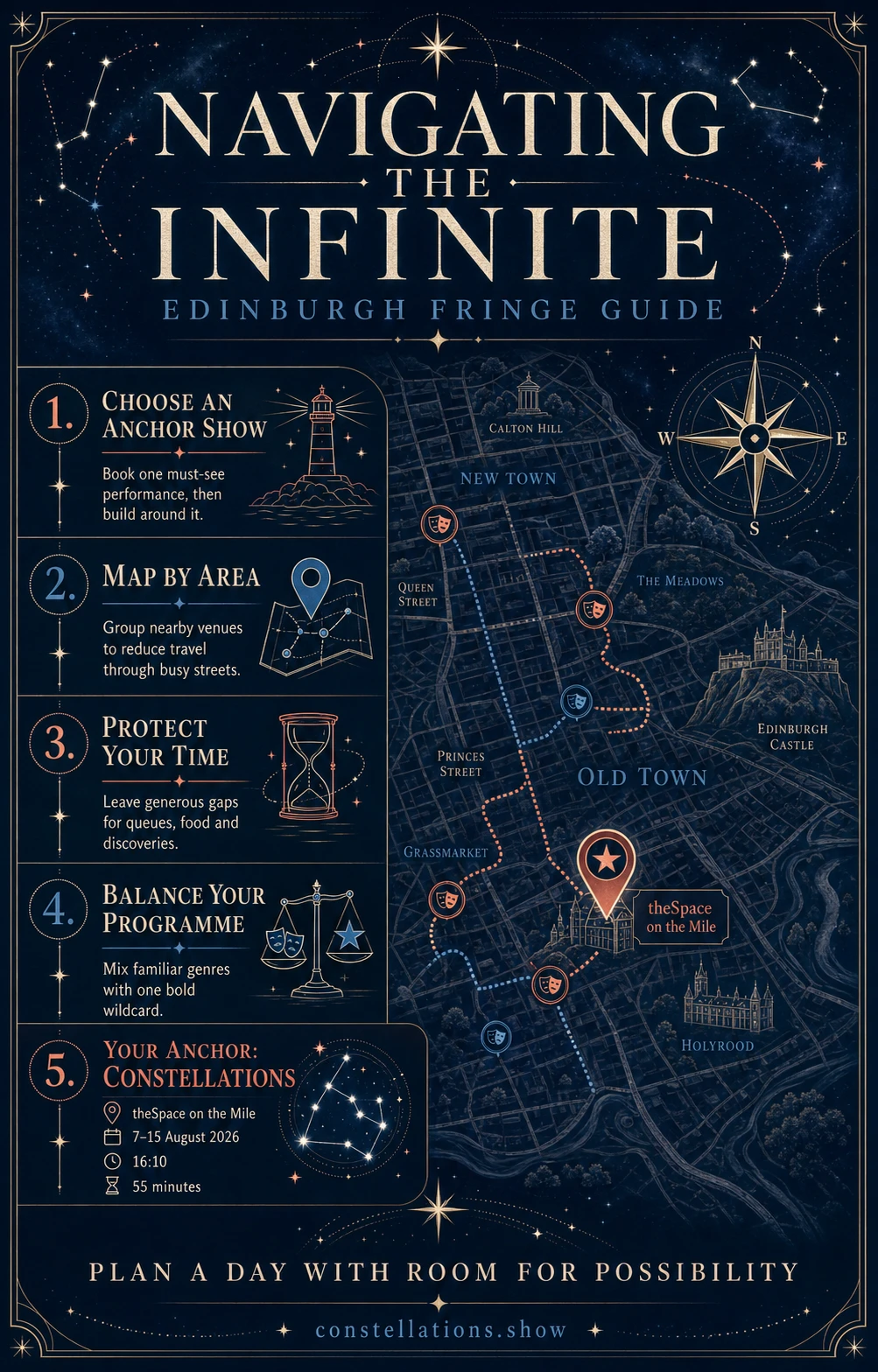
This Edinburgh Fringe guide is designed to make those possibilities manageable. The goal is not to create a minute-by-minute schedule. It is to build a flexible framework that protects your must-see performances while leaving enough room for meals, queues, weather, recommendations and the unexpected energy that makes the Fringe special.
If this is your first visit, it is also worth reading these 10 smart tips for Edinburgh Fringe first-timers and the practical guide to 12 things to know before going to Edinburgh Fringe 2026. Together, they provide useful context for the planning method below.
Key Takeaways
- Begin with one must-see anchor performance and build the day around it.
- Group shows by neighbourhood instead of crossing the city repeatedly.
- Leave realistic gaps for queues, food, weather and crowded streets.
- Mix different genres, running times and venue sizes to avoid festival fatigue.
- Keep one flexible slot for a recommendation or unexpected discovery.
- A 55-minute Old Town show such as Constellations can make a practical afternoon anchor.
Why Edinburgh Fringe Planning Feels Overwhelming
The Fringe is not a conventional festival contained within one park or theatre complex. Performances happen throughout Edinburgh in purpose-built theatres, converted halls, university rooms, bars, basements, churches and temporary spaces. Two shows that look close together in a programme may involve a steep hill, a crowded street or separate entrances within a large venue complex.
The programme also invites constant comparison. Should you choose a major production, an emerging company, a late-night recommendation or a show with only a few performances? There is no single correct answer. The most useful question is not “What are the objectively best shows?” but “What kind of Fringe day do I want?”
For a broader starting point, see the ultimate guide to Edinburgh Fringe 2026. If your main concern is selecting strong theatre, the guide to choosing the right Edinburgh Fringe show offers a more focused approach.
Choose One Anchor Show
An anchor show is the performance you would be most disappointed to miss. It gives your day a fixed time and location. Once that decision is made, the hundreds of other possibilities become easier to evaluate.
Your anchor does not need to be the largest, most expensive or most heavily reviewed production. It might be a specific actor, playwright, subject or theatrical style that genuinely interests you. It could also be an intimate show whose limited capacity makes advance booking sensible.
How to identify your anchor
- Choose a performance that matches your strongest interest.
- Confirm the exact venue address, date, start time and running time.
- Check content guidance and accessibility information before booking.
- Consider how early you should arrive and whether latecomers are admitted.
- Build the rest of the programme outward from that fixed point.
If the size of the programme is making the decision difficult, read how to choose what to see at the Edinburgh Fringe. It explains why personal relevance is often a better filter than trying to follow every review or recommendation.
Map Your Day by Area
Edinburgh is compact on a map, but its hills, closes, stairways and August crowds change the practical distance between venues. The safest approach is to organise your day into geographic clusters.
Old Town and the Royal Mile
The Old Town contains a dense concentration of venues and festival activity. It is ideal for combining several performances without long cross-city journeys, but the Royal Mile can become extremely busy. A ten-minute walk in quiet conditions may take considerably longer in the middle of the day.
If you want contemporary drama in this area, the guide to live theatre on Edinburgh’s High Street offers relevant suggestions and local context.
Other venue clusters
Rather than naming every area in advance, check where your chosen venues actually sit and group nearby performances. Venue brands sometimes operate multiple spaces, so always use the complete address attached to the individual show.
A useful rule is to minimise major changes of area. One move between clusters may be reasonable; repeated journeys across the city consume time and energy that could be spent seeing work or enjoying Edinburgh.
Protect Your Time Between Shows
Back-to-back bookings can look efficient, but they leave no margin for real Fringe conditions. A show may release its audience slightly later than expected. Streets may be crowded. You may need to collect a ticket, find the correct room inside a venue or simply stop for water.
Allow more time than the map suggests, particularly if you are changing neighbourhoods. When performances are very close, a shorter interval may work. Otherwise, a generous buffer protects both bookings and keeps the day enjoyable.
Why shorter shows help
A concise performance can provide structure without consuming an entire afternoon or evening. This is one reason 55-minute shows work particularly well at Edinburgh Fringe. They leave time for travel, food, discussion and another performance without making the audience feel rushed.
If you are deliberately building a varied day, browse this selection of the best Edinburgh Fringe shows under 60 minutes.
Balance Genres, Lengths and Energy
Seeing several similar shows in succession can make them blur together. A balanced programme changes rhythm. You might pair an intimate afternoon drama with comedy, music or a larger evening production. You could follow an emotionally demanding performance with time outdoors rather than another intense show.
Venue scale matters too. Large productions generate collective excitement, while small rooms can create extraordinary concentration. Theatre lovers may want to explore the guide to the best intimate theatre shows at Edinburgh Fringe 2026 or the selection of contemporary theatre shows at the Fringe.
Use contrast deliberately
- Alternate serious and lighter material.
- Mix spoken theatre with music, movement or another performance form.
- Combine one established title with one unfamiliar company.
- Balance seated indoor performances with time walking outside.
- Avoid placing two emotionally demanding shows too close together.
Leave Room for an Unexpected Discovery
The Fringe rewards preparation, but it also rewards curiosity. A flyer, a conversation in a queue or an enthusiastic recommendation may lead you to a performance you had never considered. Leave one flexible slot so that accepting such a recommendation does not require sacrificing an expensive booking.
Discovery does not mean choosing blindly. Read the description, confirm the venue and check that the show’s tone suits your group. The guide to hidden gems at Edinburgh Fringe 2026 provides a useful place to begin.
It is also worth understanding how Fringe audiences actually choose shows. Reviews matter, but timing, location, personal recommendations and the emotional promise of a show frequently matter just as much.
Plan a Fringe Day Around Your Budget
A good schedule is also a financially realistic one. Decide how many paid performances you want to prioritise, then account for food, drinks and transport. Booking every available hour may create both financial pressure and festival fatigue.
Mixing one priority ticket with lower-cost discoveries can make the day feel more adventurous without losing structure. For practical ideas, see Edinburgh Fringe on a budget.
Use Constellations as an Old Town Anchor
Theatre33’s production of Nick Payne’s Constellations makes a practical anchor for an Old Town theatre day. The play follows Marianne, a quantum cosmologist, and Roland, a beekeeper, through multiple possible versions of their relationship. Its structure reflects the very problem every Fringe visitor faces: one choice creates another path.
The production stars Era Pogosova as Marianne and Christophe Peyras as Roland, directed by Marianna Chebotaryova.
- Venue: theSpace on the Mile, 80 High Street, Edinburgh
- Dates: 7–15 August 2026
- Time: 16:10 daily
- Running time: 55 minutes
The central location and concise running time leave room for lunch beforehand, another performance later and time to discuss the play. Readers unfamiliar with the story can start with what Constellations is about or the complete guide to Nick Payne’s Constellations at Edinburgh Fringe.
If the repeated structure concerns you, the explanations of why Constellations repeats scenes and why the play is not confusing describe how the storytelling works without requiring a background in physics.
A Sample Edinburgh Fringe Day
The following itinerary is deliberately spacious. Use it as a structure rather than a rigid prescription.
- Late morning: Arrive in the Old Town, orient yourself and allow time to explore.
- Lunch: Eat before the busiest part of the afternoon rather than squeezing food between performances.
- 15:30: Make your way toward theSpace on the Mile and locate the correct entrance.
- 16:10: See Constellations.
- After 17:05: Walk, have a drink or discuss the performance without rushing onward.
- Evening: Choose a contrasting performance nearby or keep the slot flexible for a recommendation.
How many shows belong in one day depends on your energy, travel distance and preferred pace. The detailed guide to how many Fringe shows you can realistically see in one day can help you set expectations.
Common Edinburgh Fringe Planning Mistakes
Booking only by title
Read the full description, running time, venue and content information. An appealing title alone may not communicate the form or tone of a performance.
Underestimating travel
A short distance may include crowds, hills and unfamiliar venue entrances. Protect each ticket by building in a buffer.
Scheduling every meal as an afterthought
Food, water and rest affect how much you enjoy the work. Include them in the day rather than hoping a gap appears.
Following reviews without considering personal taste
A highly praised show may still be wrong for your mood or group. Use reviews as evidence, not instructions.
Leaving no room for the Fringe itself
If every minute is committed, you lose the freedom to respond to the city. A flexible hour is not wasted time; it is part of the festival experience.
Book Your Old Town Anchor Show
If Constellations fits your route, interests and preferred pace, reserve the performance first and let the rest of the day form around it. The dedicated ticket guide for Constellations at Edinburgh Fringe 2026 provides additional booking information.
Book tickets through the official Edinburgh Festival Fringe listing.
Frequently Asked Questions
How early should I arrive for a Fringe show?
Follow the individual venue’s guidance and allow extra time during busy periods. Confirm the exact entrance before the performance, especially when one venue complex contains several rooms.
How many shows should I see in one day?
There is no ideal number. Two to four well-spaced performances often create a more enjoyable day than a rushed marathon. Location and running time matter as much as the total.
Should I book every show in advance?
Book priority performances in advance, particularly when the date or time is important. Leave at least one flexible period if spontaneous discovery is part of what you enjoy about festivals.
How much time should I leave between Fringe shows?
It depends on the venues. Nearby performances may require a smaller buffer, while different neighbourhoods need considerably more time. Include queues, hills and crowded streets in the calculation.
Where should a first-time Fringe visitor begin?
Choose one show that genuinely interests you, learn its neighbourhood and build outward from there. Avoid trying to understand the entire programme before making your first decision.
Is Constellations suitable for people who do not understand quantum physics?
Yes. Quantum theory shapes the play’s repeating structure, but its focus is the recognisable relationship between Marianne and Roland. No scientific background is required. The play includes mature emotional themes involving illness and grief.
Where and when is Constellations playing?
Theatre33 presents Constellations at theSpace on the Mile, 80 High Street, from 7–15 August 2026 at 16:10 daily. The performance runs for approximately 55 minutes.