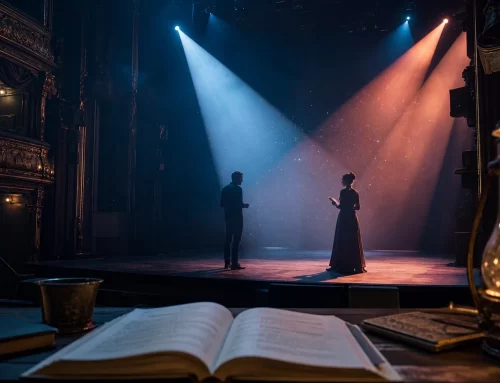
Why Great Scripts Matter: Contemporary Drama at Edinburgh Fringe

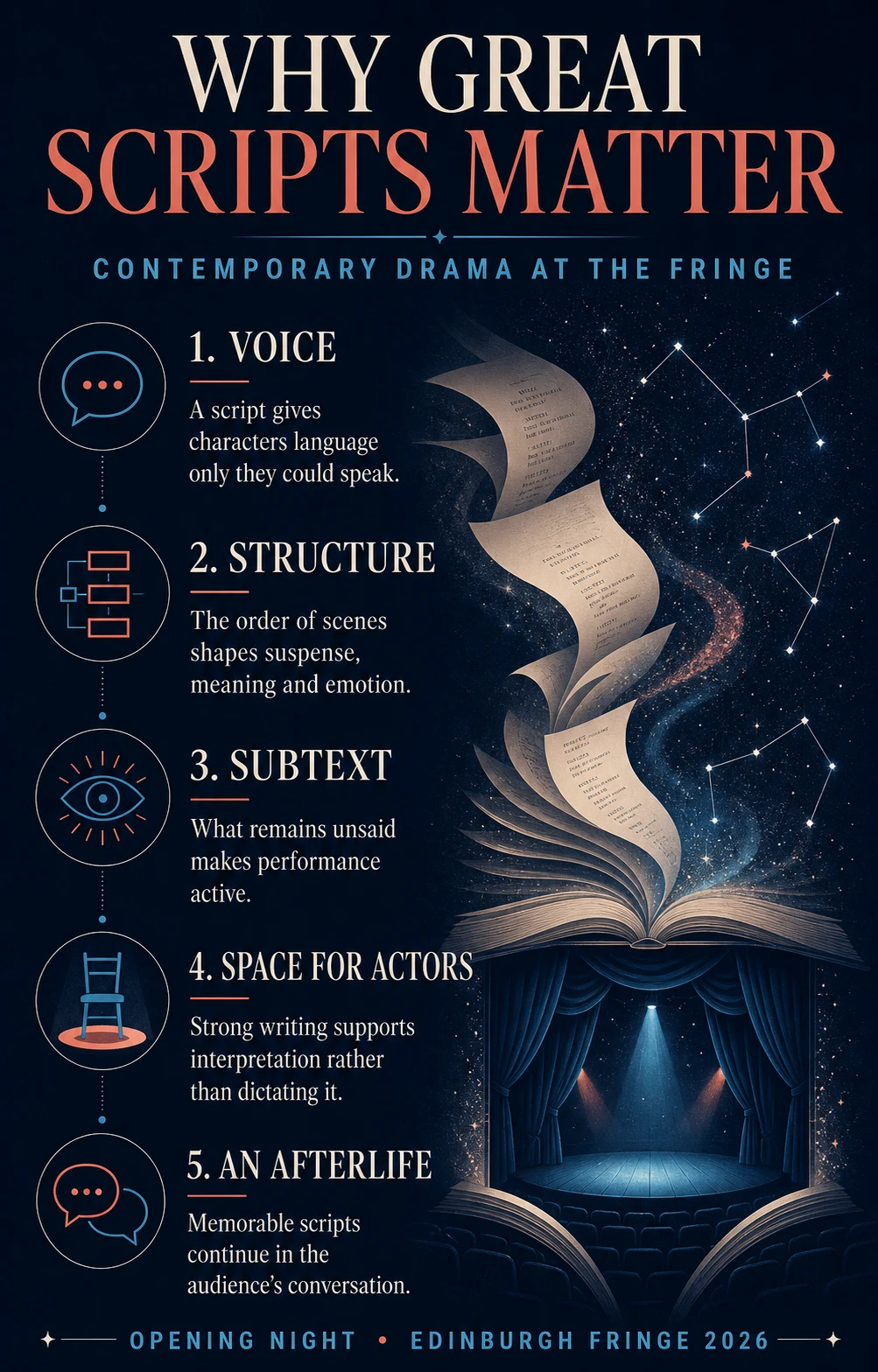
Opening night reveals what a script was built to do. Voice becomes sound, subtext becomes behaviour and structure becomes an experience shared with a live audience.
This complete guide examines contemporary drama scripts Edinburgh Fringe from the perspective of audiences planning a real Fringe visit. It combines artistic context, practical decision-making and examples from the official 2026 programme without treating any single show as the only worthwhile choice.
Key Takeaways
- What makes a script theatrical?
- Why is subtext essential?
- How does structure guide emotion?
- What freedom should actors have?
- How does rehearsal change interpretation?
What makes a script theatrical?
Opening night reveals what a script was built to do. Voice becomes sound, subtext becomes behaviour and structure becomes an experience shared with a live audience. This question matters at Edinburgh because the Fringe places radically different kinds of work beside one another. Audiences are not choosing between identical products; they are choosing between experiences with different scales, tones, traditions and ambitions.
A useful way to approach contemporary drama scripts Edinburgh Fringe is to separate evidence from expectation. Evidence includes the show description, named artists, running time, form, venue, content information and any verifiable history. Expectation is personal: the mood you want, the people attending with you, your energy at that hour and the other work in your schedule.
Craft becomes visible through specificity. Strong theatre makes deliberate choices about language, rhythm, space and audience relationship. Those choices do not guarantee that every spectator will enjoy the result, but they give the work coherence and allow a meaningful response.
After the performance, ask what changed between the beginning and the end, what the live form added, and which moments remain vivid. These questions move discussion beyond a simple star rating.
Why is subtext essential?
Opening night reveals what a script was built to do. Voice becomes sound, subtext becomes behaviour and structure becomes an experience shared with a live audience. This question matters at Edinburgh because the Fringe places radically different kinds of work beside one another. Audiences are not choosing between identical products; they are choosing between experiences with different scales, tones, traditions and ambitions.
A useful way to approach contemporary drama scripts Edinburgh Fringe is to separate evidence from expectation. Evidence includes the show description, named artists, running time, form, venue, content information and any verifiable history. Expectation is personal: the mood you want, the people attending with you, your energy at that hour and the other work in your schedule.
The Fringe rewards curiosity, but curiosity works best with context. Read enough to understand the proposed experience without demanding that a listing reveal every surprise. A clear premise, credible creative intention and appropriate practical fit form a stronger basis than hype alone.
Before booking, compare this possibility with the rest of your day. Contrast often improves attention: an intimate drama can follow comedy, while a formally experimental work may benefit from an unhurried break afterwards.
How does structure guide emotion?
Opening night reveals what a script was built to do. Voice becomes sound, subtext becomes behaviour and structure becomes an experience shared with a live audience. This question matters at Edinburgh because the Fringe places radically different kinds of work beside one another. Audiences are not choosing between identical products; they are choosing between experiences with different scales, tones, traditions and ambitions.
A useful way to approach contemporary drama scripts Edinburgh Fringe is to separate evidence from expectation. Evidence includes the show description, named artists, running time, form, venue, content information and any verifiable history. Expectation is personal: the mood you want, the people attending with you, your energy at that hour and the other work in your schedule.
Craft becomes visible through specificity. Strong theatre makes deliberate choices about language, rhythm, space and audience relationship. Those choices do not guarantee that every spectator will enjoy the result, but they give the work coherence and allow a meaningful response.
Before booking, compare this possibility with the rest of your day. Contrast often improves attention: an intimate drama can follow comedy, while a formally experimental work may benefit from an unhurried break afterwards.
What freedom should actors have?
Opening night reveals what a script was built to do. Voice becomes sound, subtext becomes behaviour and structure becomes an experience shared with a live audience. This question matters at Edinburgh because the Fringe places radically different kinds of work beside one another. Audiences are not choosing between identical products; they are choosing between experiences with different scales, tones, traditions and ambitions.
A useful way to approach contemporary drama scripts Edinburgh Fringe is to separate evidence from expectation. Evidence includes the show description, named artists, running time, form, venue, content information and any verifiable history. Expectation is personal: the mood you want, the people attending with you, your energy at that hour and the other work in your schedule.
The Fringe rewards curiosity, but curiosity works best with context. Read enough to understand the proposed experience without demanding that a listing reveal every surprise. A clear premise, credible creative intention and appropriate practical fit form a stronger basis than hype alone.
After the performance, ask what changed between the beginning and the end, what the live form added, and which moments remain vivid. These questions move discussion beyond a simple star rating.
How does rehearsal change interpretation?
Opening night reveals what a script was built to do. Voice becomes sound, subtext becomes behaviour and structure becomes an experience shared with a live audience. This question matters at Edinburgh because the Fringe places radically different kinds of work beside one another. Audiences are not choosing between identical products; they are choosing between experiences with different scales, tones, traditions and ambitions.
A useful way to approach contemporary drama scripts Edinburgh Fringe is to separate evidence from expectation. Evidence includes the show description, named artists, running time, form, venue, content information and any verifiable history. Expectation is personal: the mood you want, the people attending with you, your energy at that hour and the other work in your schedule.
Craft becomes visible through specificity. Strong theatre makes deliberate choices about language, rhythm, space and audience relationship. Those choices do not guarantee that every spectator will enjoy the result, but they give the work coherence and allow a meaningful response.
Before booking, compare this possibility with the rest of your day. Contrast often improves attention: an intimate drama can follow comedy, while a formally experimental work may benefit from an unhurried break afterwards.
Why do certain scripts outlive a production?
Opening night reveals what a script was built to do. Voice becomes sound, subtext becomes behaviour and structure becomes an experience shared with a live audience. This question matters at Edinburgh because the Fringe places radically different kinds of work beside one another. Audiences are not choosing between identical products; they are choosing between experiences with different scales, tones, traditions and ambitions.
A useful way to approach contemporary drama scripts Edinburgh Fringe is to separate evidence from expectation. Evidence includes the show description, named artists, running time, form, venue, content information and any verifiable history. Expectation is personal: the mood you want, the people attending with you, your energy at that hour and the other work in your schedule.
The Fringe rewards curiosity, but curiosity works best with context. Read enough to understand the proposed experience without demanding that a listing reveal every surprise. A clear premise, credible creative intention and appropriate practical fit form a stronger basis than hype alone.
Before booking, compare this possibility with the rest of your day. Contrast often improves attention: an intimate drama can follow comedy, while a formally experimental work may benefit from an unhurried break afterwards.
Continue Exploring the Topic
- how Constellations is built in rehearsal
- drama shows at Edinburgh Fringe
- intimate theatre at Edinburgh Fringe
- what memorable Fringe shows have in common
Other 2026 Fringe Shows Worth Comparing
A broad article should not pretend that one production represents the entire Fringe. The following official listings illustrate different approaches related to this topic. They are examples rather than a definitive ranking; dates, availability, access information and warnings should always be confirmed on the listing before booking.
Edward Albee’s The Zoo Story
Edward Albee’s The Zoo Story offers an award-winning one-hour drama built around an unsettling encounter. It provides a useful comparison because its form, tone or subject approaches the article’s central question from another direction. Read the official description carefully and decide whether that experience complements the rest of your programme.
Hamlet
Hamlet offers a contemporary international staging of Shakespeare’s existential tragedy. It provides a useful comparison because its form, tone or subject approaches the article’s central question from another direction. Read the official description carefully and decide whether that experience complements the rest of your programme.
The Passion
The Passion offers a contemporary retelling through monologue and song. It provides a useful comparison because its form, tone or subject approaches the article’s central question from another direction. Read the official description carefully and decide whether that experience complements the rest of your programme.
The Lady Doth Protest
The Lady Doth Protest offers a sharp present-day confrontation with Shakespeare and whose voice gets heard. It provides a useful comparison because its form, tone or subject approaches the article’s central question from another direction. Read the official description carefully and decide whether that experience complements the rest of your programme.
Practical Planning for Edinburgh Fringe 2026
The 2026 Edinburgh Festival Fringe runs from 7–31 August. More than 3,500 shows have been announced, so no article can replace checking the official programme. Confirm the full venue address rather than relying only on a venue brand, allow for hills and crowds, and check age guidance, warnings and access information for each person in your group.
Choose one anchor
Begin with the performance you would be most disappointed to miss. Once its time and neighbourhood are fixed, nearby choices become easier to assess. Avoid building a schedule that depends on every show ending exactly on time and every street remaining clear.
Protect food, travel and reflection
Meals and travel are not empty gaps. They determine whether you arrive ready to pay attention. Emotionally demanding theatre also benefits from breathing room afterwards. A smaller number of well-spaced performances frequently produces a richer day than a rushed sequence.
Use official information
Descriptions may change and availability moves quickly. Use the official Fringe listing or venue box office for current details. If access is important, verify the information for the specific performance rather than assuming every room in a venue complex has identical provision.
Where Constellations Fits
Nick Payne’s Constellations follows Marianne, a quantum cosmologist, and Roland, a beekeeper, through multiple possible versions of their relationship. Theatre33’s production stars Era Pogosova and Christophe Peyras and is directed by Marianna Chebotaryova. It plays at theSpace on the Mile, 80 High Street, from 7–15 August 2026 at 16:10 daily and runs for approximately 55 minutes.
The production is relevant here because opening night reveals what a script was built to do. voice becomes sound, subtext becomes behaviour and structure becomes an experience shared with a live audience. It is one example within a much larger programme, and audiences should compare its intimate two-person form with other work that matches their interests.
Tickets are available from theSpaceUK box office and the official Edinburgh Fringe listing.
Frequently Asked Questions
What makes a script theatrical?
Opening night reveals what a script was built to do. Voice becomes sound, subtext becomes behaviour and structure becomes an experience shared with a live audience.
Why is subtext essential?
There is no universal answer because audiences, productions and practical circumstances differ. Use verified information, identify the experience you want, and leave enough space in the schedule to engage with the performance rather than merely collect it.
How does structure guide emotion?
Opening night reveals what a script was built to do. Voice becomes sound, subtext becomes behaviour and structure becomes an experience shared with a live audience.
What freedom should actors have?
There is no universal answer because audiences, productions and practical circumstances differ. Use verified information, identify the experience you want, and leave enough space in the schedule to engage with the performance rather than merely collect it.
How does rehearsal change interpretation?
Opening night reveals what a script was built to do. Voice becomes sound, subtext becomes behaviour and structure becomes an experience shared with a live audience.
Why do certain scripts outlive a production?
There is no universal answer because audiences, productions and practical circumstances differ. Use verified information, identify the experience you want, and leave enough space in the schedule to engage with the performance rather than merely collect it.
When and where is Constellations playing?
It runs at theSpace on the Mile, 80 High Street, from 7–15 August 2026 at 16:10 daily. The performance lasts approximately 55 minutes.
Where can tickets be purchased?
Use theSpaceUK or the official Fringe listing.