A Guide to Nick Payne’s Constellations at the Edinburgh Fringe

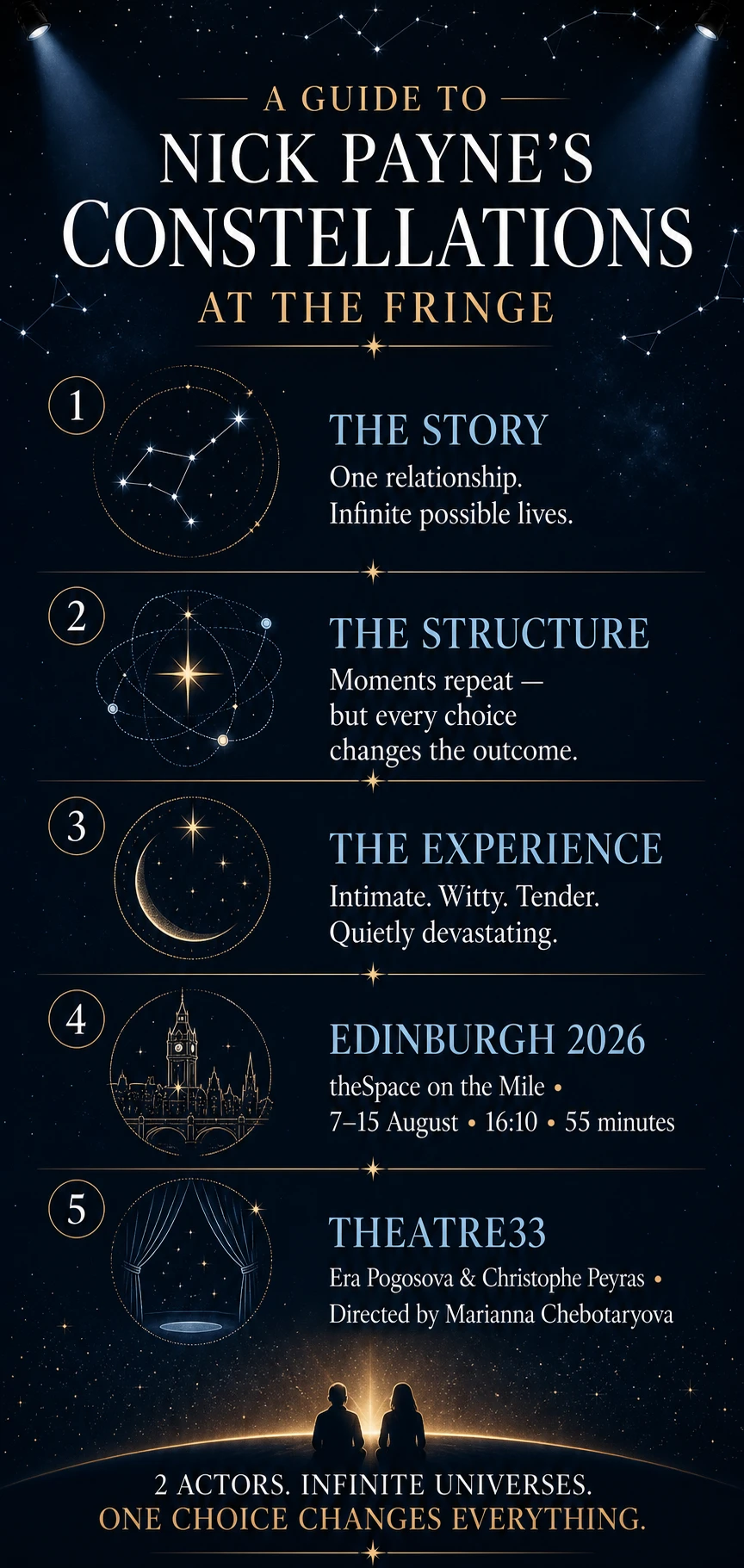
What if the smallest change—a pause, a glance, a word spoken differently—could create an entirely new life? At the Edinburgh Fringe, audiences make hundreds of choices every day. Which street to follow. Which flyer to accept. Which performance deserves an hour of their limited time. For anyone searching for Nick Payne Constellations Edinburgh Fringe, this guide explains why Theatre33’s intimate production deserves a place in that carefully planned festival schedule. Constellations is a love story told through parallel possibilities. Marianne and Roland meet, separate, reconnect, laugh, argue, and face the unimaginable across multiple versions of their relationship. Theatre33 brings this acclaimed contemporary two-hander to theSpace on the Mile from 7–15 August 2026, with daily performances at 16:10. Here is everything to know about the play, its unusual structure, the company behind the production, and how to plan your visit.
Key Takeaways
- Constellations is Nick Payne’s intimate two-person play about love, choice, and the infinite lives that might follow a single decision.
- The scenes repeat with subtle variations, allowing different versions of Marianne and Roland’s relationship to exist alongside one another.
- No knowledge of quantum physics is required. The scientific ideas provide the structure, but the play’s emotional story remains direct and accessible.
- Theatre33 performs at theSpace on the Mile from 7–15 August 2026 at 16:10 daily. The performance lasts approximately 55 minutes.
- The production features Era Pogosova and Christophe Peyras, directed by Marianna Chebotaryova.
What Is Nick Payne’s Constellations About?
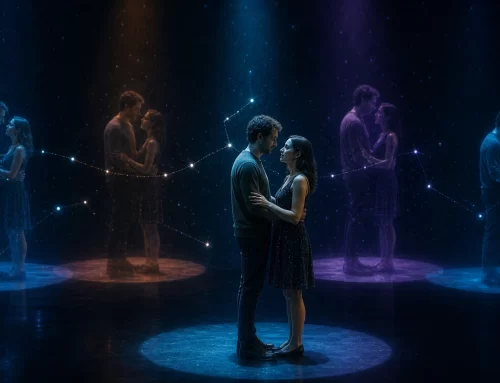
Nick Payne’s Constellations begins with an encounter between two people who seem to come from completely different worlds. Marianne is a quantum cosmologist. Roland is a beekeeper. Their first conversation can be funny, awkward, promising, or over almost before it begins. The play then returns to that moment—and to many others—but each time something changes. A different response opens another possibility. A hesitation closes one. A relationship begins in one reality and disappears in another. The result is not one straightforward romance. It is a constellation of possible romances, all formed from the same two people.
A Love Story Told Through Possibility
At the heart of the play is a recognisable human question: what might have happened if one moment had unfolded differently? We ask ourselves versions of that question constantly. What if I had stayed? What if I had spoken? What if I had arrived five minutes earlier? Constellations places those invisible questions on stage. Instead of choosing one definitive path for Marianne and Roland, the play allows several paths to exist. Some are joyful. Some are uncomfortable. Some are painfully brief. Together, they reveal a relationship more completely than a single timeline could.
Science Creates the Form, Not the Homework
The play draws inspiration from ideas about multiple universes and the possibility that every outcome may exist somewhere. But audiences do not need a scientific background to follow it. Marianne’s understanding of cosmology gives language to the structure. The emotional meaning comes from something more familiar: two people trying to connect while timing, fear, chance, and mortality keep changing the conditions around them. The science expands the scale of the story. The performances keep it human.
How the Multiverse Structure Works on Stage
If you are researching Nick Payne Constellations Edinburgh Fringe, you may have heard that the play repeats scenes. It does—but “repetition” only describes the surface. Each return to a moment introduces a variation. A line is delivered with a different intention. Someone listens instead of interrupting. Confidence becomes uncertainty. Affection becomes distance. The words may remain similar while the emotional reality changes completely.
Small Changes, Different Universes
The pleasure of watching Constellations comes from noticing how much meaning can be carried by a very small change. In ordinary life, a pause may seem insignificant. On stage, that pause can create another universe. The actors must move rapidly between emotional possibilities without relying on lengthy transitions or explanations. The audience learns the play’s language by watching the shifts: a change in rhythm, posture, proximity, light, or silence.
Do You Need to Track Every Timeline?
No. The play is not asking you to construct a diagram or identify one “correct” sequence of events. Its structure works through recognition rather than analysis. You understand that the circumstances have changed. You recognise the emotional stakes. You feel the consequence. That is enough. The experience becomes richer when audiences stop trying to solve the multiverse and allow its different possibilities to accumulate.
Meet Marianne and Roland
The scale of Constellations may be cosmic, but the entire story depends on two people. Marianne works with theories that attempt to explain the universe. Roland works with bees, honey, and the physical rhythms of the natural world. Their professions initially make them appear like opposites: abstract and practical, celestial and grounded. Yet both characters are searching for patterns. Both are trying to understand forces larger than themselves. Both discover that knowledge does not protect anyone from vulnerability.
Why the Two-Hander Format Matters
With only two performers, every detail becomes visible. There is no large ensemble to redirect attention. No spectacle can replace emotional precision. Every version of the relationship depends on the actors’ ability to listen, respond, and transform a familiar exchange into something newly alive. This makes Constellations particularly suited to an intimate Fringe venue. When the performers are close, the audience can see the exact moment when one possibility becomes another.
Romantic, Funny, and Devastating
Descriptions of the play often focus on quantum physics or its unusual chronology. Those elements are important, but they can obscure how funny and warmly human the writing can be. Marianne and Roland misunderstand one another. They flirt badly. They surprise each other. They find joy in moments that might not exist anywhere else. That humour is essential. It gives the later emotional turns their weight and prevents the play from becoming a purely intellectual exercise.
Why Constellations Belongs at the Edinburgh Fringe
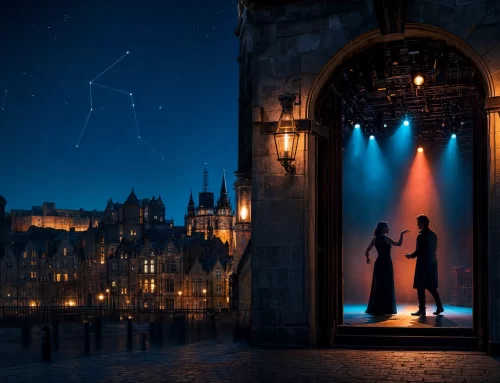
The Edinburgh Festival Fringe is built around possibility. Every day offers more performances than one person could ever see. Audiences create their own festival from thousands of potential schedules, knowing that each decision means missing something else. That makes the Fringe an especially fitting home for a play about choices and alternate paths.
A Quiet Contrast to Festival Noise
Edinburgh in August can be exhilarating and overwhelming. Streets fill with performers, flyers, music, queues, and conversations competing for attention. Constellations offers a different kind of intensity. It is focused rather than loud. Intimate rather than expansive. It asks an audience to pay attention to the smallest shifts between two people. For festival-goers who want contemporary drama with emotional and intellectual depth, that contrast can be exactly what makes a show memorable.
Fifty-Five Minutes That Continue Afterwards
Theatre33’s production runs for approximately 55 minutes, making it easy to place within a full Fringe itinerary. But the experience does not feel disposable. The play tends to continue in the conversations that follow it. Audiences leave thinking about the versions of their own lives that nearly happened—the message not sent, the invitation declined, the chance encounter that changed everything.
The Theatre33 Production
Theatre33 brings Constellations from Bellevue, Washington, to the Edinburgh Fringe Festival 2026. The production is performed by Era Pogosova and Christophe Peyras and directed by Marianna Chebotaryova. Its approach places performance, timing, and emotional detail at the centre of the experience. Rather than attempting to illustrate every universe literally, the staging gives audiences room to imagine them.
Performance Over Spectacle
The structure of Constellations demands clarity. Audiences must recognise when a moment begins again while remaining emotionally engaged with what has changed. Theatre33’s production uses a focused theatrical language to support those transitions. Light, sound, movement, and rhythm help signal each shift without overwhelming the relationship at the centre of the play. The result is a production designed to feel precise but not mechanical, minimal but not empty.
An International Perspective
Theatre33 is a multilingual theatre company whose artists bring different cultural and linguistic experiences into the rehearsal room. That international perspective is well suited to a play about the many ways a single life might unfold. Marianne and Roland’s story is specific, but its questions move easily across borders: How do people connect? How do they fail to connect? What survives when circumstances change?
Planning Your Visit to theSpace on the Mile
Theatre33 performs Constellations at theSpace on the Mile during the Edinburgh Fringe Festival 2026.
- Dates: 7–15 August 2026
- Time: 16:10 daily
- Running time: approximately 55 minutes
- Venue: theSpace on the Mile
- Address: 80 High Street, Edinburgh
- Genre: contemporary drama
Why the 16:10 Performance Time Works
A late-afternoon performance can serve as a useful anchor in a busy Fringe day. There is time for a morning show, lunch, and exploration before the performance. The 55-minute duration also leaves the evening open for dinner and additional events. Because the Royal Mile becomes extremely busy during August, allow extra time to reach the venue. Arriving 15–20 minutes before the performance is a sensible target, especially if you are travelling between unfamiliar venues.
Accessibility
The official Edinburgh Fringe listing includes wheelchair access and wheelchair-accessible toilets for the venue. Visitors with specific access requirements should review the current information on the official listing before attending. You can also visit the official Constellations website for production details, the trailer, and booking links.
Who Should See Constellations?
Constellations is a strong choice for audiences who enjoy:
- contemporary British drama
- intimate two-person performances
- unusual theatrical structures
- emotionally complex love stories
- science used as a metaphor for human experience
- plays that invite conversation after the performance
Is It Suitable for a Fringe Date?
Yes—if you are comfortable seeing a play that explores both the joy and fragility of relationships. It is romantic without being sentimental and intellectually engaging without losing emotional warmth. It also gives companions something meaningful to discuss after leaving the theatre.
Content Considerations
The play includes strong language and explores illness, grief, separation, and mortality. These subjects are handled through an intimate relationship rather than through graphic imagery, but audiences sensitive to those themes should be aware of them.
Book Constellations at Edinburgh Fringe 2026
At the Fringe, every schedule creates a different festival. One decision leads to a comedy show. Another leads to a crowded street performance. Another leads through the doors of theSpace on the Mile and into Marianne and Roland’s infinite possible lives. Theatre33’s production offers a concentrated hour of contemporary theatre built on performance, precision, and emotional connection. If you are searching for Nick Payne Constellations Edinburgh Fringe, this is the essential information: theSpace on the Mile • 7–15 August 2026 • 16:10 daily • 55 minutes Book tickets through the official Edinburgh Fringe listing. Explore the production, watch the trailer, and meet the company.
Frequently Asked Questions
What is Nick Payne’s Constellations about?
Constellations follows Marianne, a quantum cosmologist, and Roland, a beekeeper, through multiple possible versions of their relationship. Small changes in words, timing, and decisions create different emotional outcomes.
Why do scenes repeat in Constellations?
The repeated scenes represent alternate possibilities. Each variation changes something important—a response, intention, pause, or circumstance—revealing another potential direction for the relationship.
Do I need to understand quantum physics?
No. Quantum theory provides the play’s imaginative framework, but the story is about recognisable human experiences: love, timing, regret, hope, illness, and choice.
Where is Constellations playing at the Edinburgh Fringe 2026?
Theatre33 performs at theSpace on the Mile, located at 80 High Street in Edinburgh’s Old Town.
When are the performances?
Performances run daily from 7–15 August 2026 at 16:10.
How long is the show?
The performance lasts approximately 55 minutes.
Who performs in Theatre33’s production?
The production features Era Pogosova and Christophe Peyras and is directed by Marianna Chebotaryova.
Is Constellations suitable for teenagers?
Older teenagers interested in contemporary drama may appreciate the play, but it includes strong language and mature themes involving illness, grief, and mortality. Parents should consider the individual viewer’s maturity.
Is the venue accessible?
The official Edinburgh Fringe listing identifies wheelchair access and wheelchair-accessible toilets. Check the current listing or contact the venue for detailed access arrangements.
Where can I buy tickets?
Tickets are available through the official Edinburgh Festival Fringe listing. The Constellations website also provides show information and booking links.