The Fringe Shows People Talk About All Year Usually Have These 5 Things in Common
Every year at the Edinburgh Fringe, thousands of shows compete for attention.
Some sell out immediately.
Some disappear almost overnight.
Some get strong reviews but fade quickly from conversation.
And then there are the rare productions people keep talking about months later.
The shows audiences recommend to friends. The ones they bring up randomly in conversations. The ones that quietly become part of someone’s memory of the Fringe itself.
Interestingly, those productions are not always the biggest shows, the loudest productions, or the most expensive ones.
Usually, they share something much more difficult to manufacture:
emotional impact.
1. They Leave an Emotional Aftereffect
Most Fringe audiences see multiple shows a day. After a while, performances can blur together.
But certain productions create emotional residue. Something lingers after the lights come up.
Maybe it is a final image. A silence. A line of dialogue. A relationship dynamic that feels painfully familiar.
The audience leaves the venue, but part of the show follows them into the street.
That emotional aftereffect is often what transforms a good show into a memorable one. It is also why emotionally intelligent theatre tends to generate strong word-of-mouth recommendations at the Fringe.
For more on this kind of emotional impact, read Why Constellations Stays With You After the Show.
2. They Feel Intimate — Even in a Festival Environment
One of the unique strengths of the Edinburgh Fringe is proximity.
Unlike large commercial productions, Fringe theatre often happens only a few feet away from the audience.
That closeness changes everything.
Small gestures suddenly matter.
Tiny emotional shifts become visible.
Silence becomes uncomfortable in the best possible way.
Audiences often remember productions that made them feel emotionally present rather than simply entertained.
This is especially true with intimate contemporary drama and smaller-scale productions.
It is one of the reasons two-handers and minimalist theatre frequently become unexpected Fringe favorites.
You can explore that idea further in Why a Two-Hander Can Hit Harder Than a Bigger Show.
3. They Start Conversations Instead of Ending Them
Many forgettable productions explain themselves completely.
Great Fringe theatre often does the opposite.
It leaves room for interpretation. Questions remain unresolved. Audience members debate what certain moments meant long after the performance ends.
That conversation becomes part of the experience itself.
This is particularly true for contemporary theatre dealing with identity, memory, relationships, grief, politics, or uncertainty.
Shows like Angels in America, A Public Display of Affection, [seagull], and Hater all create emotional and intellectual space for audiences rather than forcing simple conclusions.
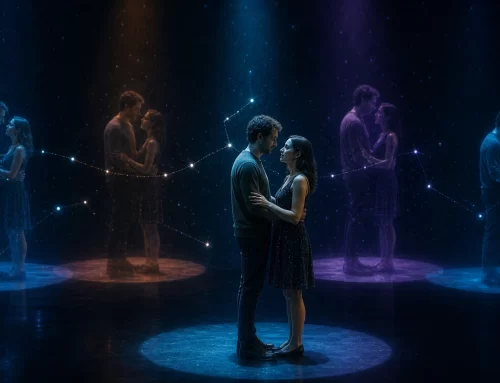
The same is true of Nick Payne’s Constellations, where multiple parallel possibilities coexist simultaneously.
The play does not ask audiences to solve a puzzle.
It asks them to sit inside uncertainty.
4. Strong Performances Matter More Than Spectacle
At the Fringe, audiences are surprisingly forgiving about scale.
People do not necessarily need massive sets or expensive visuals.
But they do remember truthful performances.
Especially in intimate theatre, acting becomes impossible to hide behind production value.
Every hesitation matters.
Every interruption matters.
Every glance matters.
This is one reason actor-driven theatre often generates stronger recommendations than visually overloaded productions.
Audiences connect to authenticity far more than spectacle.
That is also why rehearsal-based, emotionally grounded work tends to resonate so strongly at the festival.
For a closer look at how this production is built, read Inside the Rehearsal Room: How Constellations Is Built Night After Night.
5. Simplicity Often Creates More Depth
Some of the most unforgettable Fringe productions are surprisingly simple.
Two actors.
One room.
Minimal staging.
A deeply human question.
The absence of spectacle forces audiences to focus on what matters emotionally.
That simplicity can become incredibly powerful.
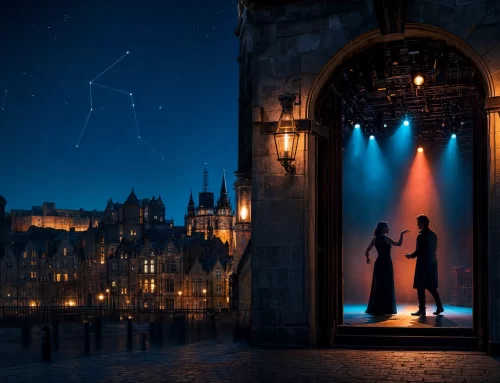
Nick Payne’s Constellations is a strong example of this.
Despite its quantum multiverse structure, the emotional core of the play is startlingly recognizable: timing, regret, missed connection, vulnerability, uncertainty, and love that changes shape over time.
That emotional realism is often what audiences remember most.
Not the concept.
The feeling.
Why Word-of-Mouth Matters So Much at the Fringe
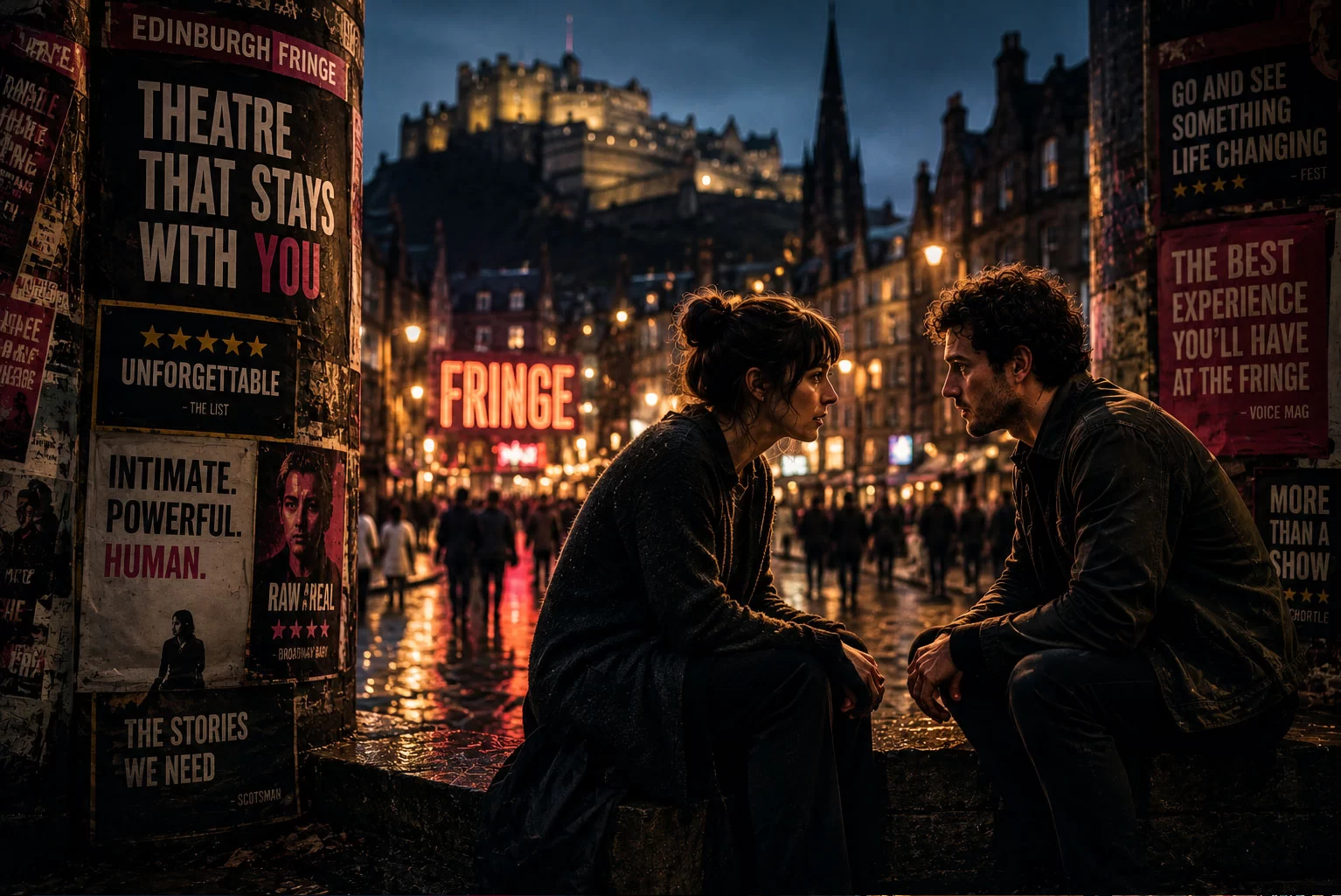
At Edinburgh Fringe, recommendation culture is everything.
People constantly ask:
“What have you seen?”
“What should I not miss?”
“What stayed with you?”
The productions that survive beyond marketing are usually the ones audiences feel personally compelled to talk about.
Not because they were trendy.
Because they felt human.
And those are often the shows people remember long after the festival ends.
See Constellations at Edinburgh Fringe 2026
Theatre33 presents Constellations by Nick Payne at theSpace on the Mile during Edinburgh Fringe 2026.
Venue: theSpace on the Mile
Dates: 7–15 August 2026
Duration: 55 minutes
If you are looking for emotionally intelligent contemporary theatre at the Fringe, learn more and book tickets here: