The Beekeeper and the Physicist: A Cosmic Bond

A beekeeper and a quantum cosmologist may seem to inhabit different worlds. In Nick Payne’s Constellations, Roland and Marianne discover that honey, physics and human connection can share the same theatrical universe.
Key Takeaways
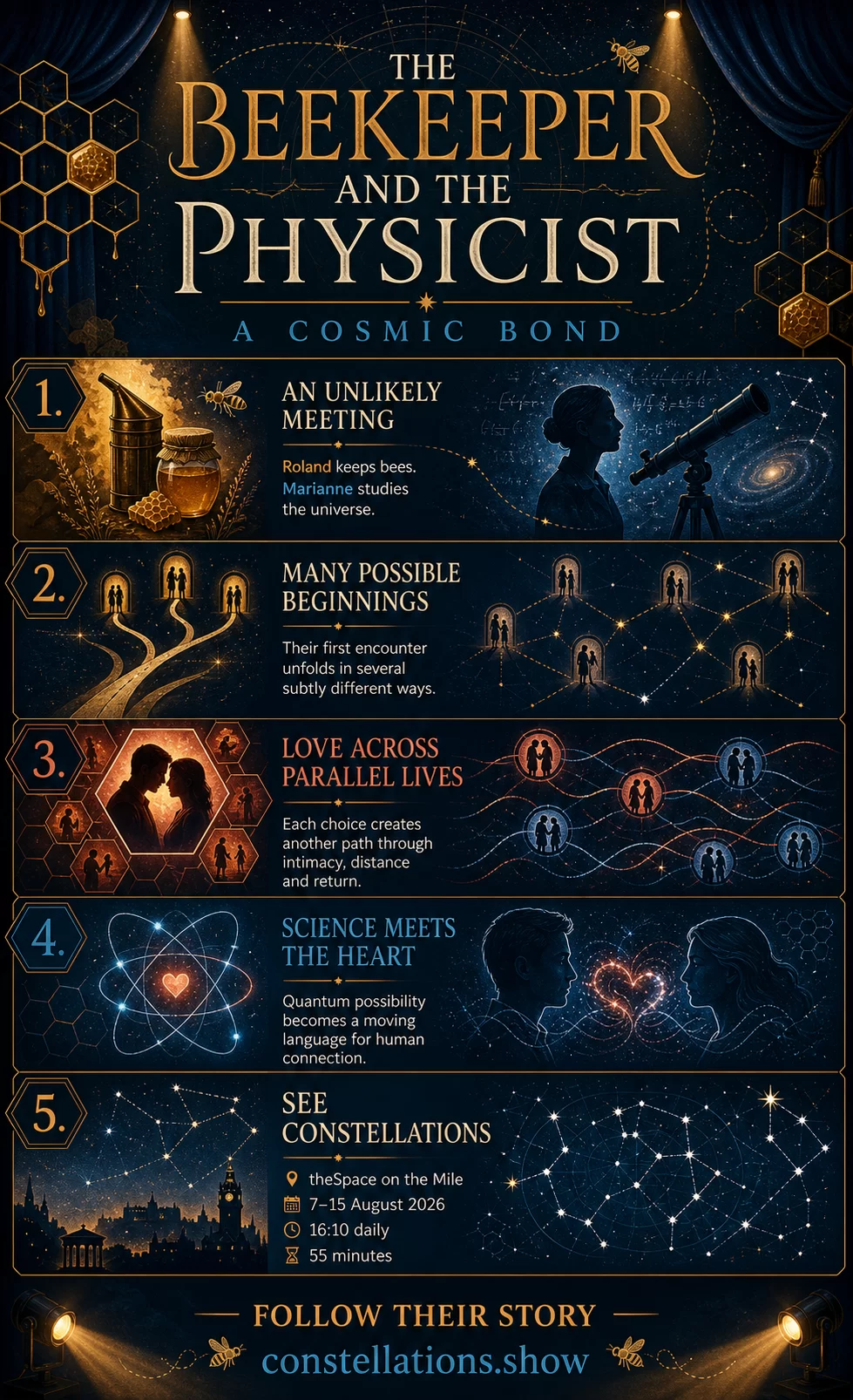
- Roland keeps bees; Marianne studies the cosmos.
- Their relationship unfolds across multiple possible realities.
- Science provides the structure, but love remains the heart of the play.
- Theatre33 presents the 55-minute drama at theSpace on the Mile.
An Unlikely Meeting
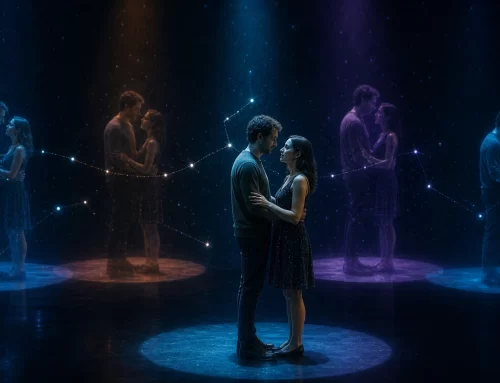
Marianne and Roland meet at a barbecue. The scene immediately returns in another form, then another. Sometimes they connect; sometimes they do not. With every variation, the audience sees how fragile and miraculous a beginning can be.
Love Across Parallel Possibilities
The play imagines that every choice may lead to another universe. Yet its greatest achievement is intimacy. Alternate realities allow Payne to examine attraction, commitment, separation, illness and grief from several emotional angles.
Why Bees and Physics Belong Together
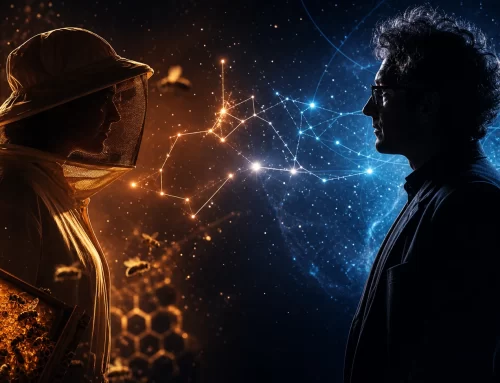
Roland’s practical knowledge of bees contrasts with Marianne’s immense theoretical universe. Both fields reveal complex systems, patterns and forces beyond individual control. Their professions give the romance texture while reinforcing the play’s questions about fate and free will.
Roland: A Life Grounded in Nature
Roland’s work as a beekeeper gives him a practical relationship with systems he can observe but never completely control. A hive depends on pattern, cooperation and conditions beyond one individual. His profession is not shorthand for simplicity; it contains its own complexity, just as Marianne’s science contains an emotional dimension.
Marianne: Looking Toward Infinite Possibility
Marianne studies quantum cosmology and introduces the possibility that every outcome exists in another universe. On paper, the premise sounds intellectual. In performance, it becomes intimate: perhaps a relationship begins in one reality, fails in another and survives somewhere else.
Read whether you need to like science to love Constellations and why it is not too intellectual in the way people assume.
What Their Professions Reveal About Love
Beekeeping and cosmology both ask people to find meaning in complex systems. Roland and Marianne do the same with their relationship. They try to understand cause and effect, yet emotion refuses to behave like a controlled experiment.
The contrast creates humour and tenderness. Their vocabularies and instincts differ, but those differences become a route toward connection.
A Love Story Without a Straight Line
Most romances move from meeting to conflict and resolution. Constellations gives the audience several meetings, conflicts and possible resolutions. The result resembles memory, where moments are replayed and imagined differently.
Explore whether Constellations is a love story, why it feels more like real life than many romances, and the best love stories at Edinburgh Fringe.
Why Two Performers Are Enough
The multiverse is built through two actors. Changes in pace, posture and eye contact establish each reality. Discover why a two-hander can hit harder than a bigger show and browse the best two-person Fringe shows.
See Their Story in Edinburgh
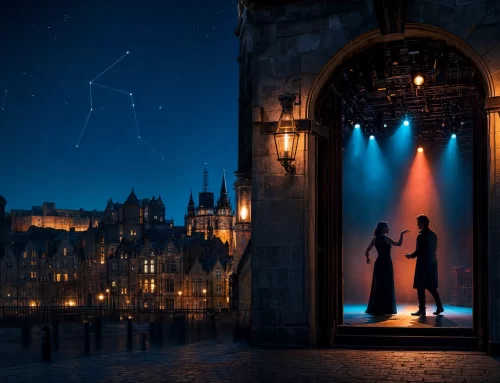
Theatre33’s production stars Era Pogosova and Christophe Peyras and is directed by Marianna Chebotaryova. See it at theSpace on the Mile, 7–15 August 2026 at 16:10 daily. Running time: 55 minutes.
From first meeting to shared history
The play’s scale grows without adding characters. A hesitant introduction becomes a relationship, and the relationship becomes a way to consider mortality. Because the audience has seen several possible beginnings, later scenes carry the emotional weight of lives that were lived and lives that vanished.
Why the pairing remains memorable
Roland and Marianne are specific enough to feel real but open enough for audiences to recognise their own experiences. Their professions make the pairing distinctive; their difficulty saying the right thing at the right time makes it universal. That mixture of intellectual curiosity and emotional imperfection allows the story to avoid both sentimentality and cold abstraction.
For a fuller introduction, visit what Constellations is about or read why the play stays with audiences.
Frequently Asked Questions
Is Constellations a science play?
Science inspires its form, but no specialist knowledge is needed.
Is it romantic?
Yes, though the story also includes mature themes of illness and grief.
Who plays Marianne and Roland?
Era Pogosova plays Marianne and Christophe Peyras plays Roland.
Why is Roland a beekeeper?
His work provides a grounded counterpoint to Marianne’s cosmology and introduces another system shaped by pattern and uncertainty.
Does the play explain the science?
It supplies enough context to understand the dramatic idea, but it is not a scientific lecture.