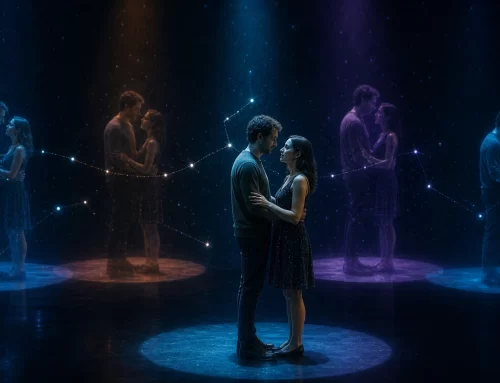
Why Constellations Feels Different Live Than It Does on Paper

Some plays are built around plot.
Some are built around spectacle.
Some rely on twists, visual scale, or elaborate theatrical machinery.
Constellations by Nick Payne works differently.
On paper, the play can appear deceptively simple:
- two people
- one relationship
- repeated conversations
- parallel possibilities
But live in a theatre, something else begins happening entirely.
The pauses become emotional.
The repetitions become human.
The silence becomes physical.
And slowly, the audience stops analyzing the structure intellectually and starts experiencing it emotionally.
That transformation is part of what makes Constellations feel so powerful in performance — especially inside an intimate Fringe venue.
The Play Lives Inside Timing
One of the strangest things about Constellations is how tiny variations completely alter emotional meaning.
A hesitation changes vulnerability.
A pause changes intimacy.
A slightly different tone changes the entire emotional temperature of a scene.
Reading the play on a page cannot fully recreate that experience because the emotional architecture depends heavily on live timing between performers.
The audience feels those changes instinctively.
Even when they cannot fully explain why.
The Repetition Feels Different Live
People often hear that Constellations repeats scenes and immediately assume the play is highly intellectual or abstract.
But live performance changes that perception dramatically.
Instead of feeling repetitive, the scenes begin feeling emotionally cumulative.
The audience starts noticing:
- small emotional shifts
- different levels of honesty
- new fears appearing
- tiny moments of vulnerability
- how one sentence changes everything
Rather than watching “alternate universes,” audiences often feel like they are watching multiple emotional truths existing simultaneously.
And strangely, that feels very close to real life.
You may also enjoy:
Silence Becomes Part of the Experience
In many productions, silence simply fills space between lines.
In Constellations, silence often becomes the scene itself.
The pauses are not empty.
They contain:
- fear
- uncertainty
- love
- regret
- hesitation
- unfinished thought
And in a live theatre environment, audiences physically experience those silences together.
You can feel a room holding its breath.
That shared tension becomes impossible to fully recreate outside performance.
Small Venues Change Everything
One reason Constellations works especially well at the Edinburgh Fringe is because of venue intimacy.
At many Fringe venues, audiences are only a few feet away from performers.
There is nowhere to emotionally hide.
Every glance matters.
Every hesitation matters.
Every emotional shift becomes visible.
Inside an intimate space like theSpace on the Mile, the audience experiences the play almost like overhearing private emotional moments unfold in real time.
That proximity transforms the emotional intensity of the play enormously.
You may also enjoy:
- Best Intimate Theatre Shows at Edinburgh Fringe 2026
- Why a Two-Hander Can Hit Harder Than a Bigger Show
The Audience Starts Feeling Alternate Possibilities
One of the most remarkable things about seeing Constellations live is that the audience eventually stops thinking about “science.”
The play stops feeling theoretical.
Instead, people begin emotionally projecting themselves into the possibilities unfolding on stage.
Audiences start recognizing:
- relationships they almost had
- conversations they replay in their own memory
- versions of themselves shaped by different timing
- moments where tiny choices changed everything
The emotional experience becomes surprisingly personal.
And often unexpectedly painful.
Why Audiences Often Leave Quietly
One of the recurring things people notice after performances of Constellations is how differently audiences leave the theatre.
Not loudly discussing plot twists.
Not immediately breaking emotional tension.
But quietly.
Thoughtfully.
As if the play continues processing internally long after the lights come up.
That emotional aftereffect is difficult to manufacture artificially.
It happens because the play touches something recognizable about uncertainty, timing, connection, and memory.
You may also enjoy:
Theatre Can Hold Multiple Emotional Truths at Once
Perhaps the most extraordinary thing about seeing Constellations live is realizing that the play is not really asking audiences to understand quantum mechanics.
It is asking audiences to accept emotional complexity.
That love can be contradictory.
That timing matters enormously.
That people can hurt each other while still caring deeply.
That multiple emotional truths can exist simultaneously.
Theatre can hold those contradictions in ways everyday life often cannot.
And live performance allows audiences to experience those contradictions together in real time.
Why the Live Experience Matters
Some stories work perfectly well through summary.
Constellations is not really one of them.
Because what makes the play resonate is not only the concept.
It is:
- timing
- breathing
- hesitation
- silence
- proximity
- emotional vulnerability
- watching tiny human moments shift in real time
Those things only fully exist inside live performance.
See Constellations at Edinburgh Fringe 2026
Theatre33 presents Constellations by Nick Payne at theSpace on the Mile during Edinburgh Fringe 2026.
Venue: theSpace on the Mile
Dates: 7–15 August 2026
Duration: 55 minutes
Learn more and book tickets for Constellations at Edinburgh Fringe 2026